
Table of Contents
Information About Natural Treatment for Beard Baldness and Tips on How to Be Bearded Again
Learn the modern ways to deal with patchy beard hair loss, including shampoos, conditioners, topical remedies, blades, oils, changes in diet and lifestyle, and other treatment methods. If you are searching for an alopecia barbae cure, understanding the condition and the available treatment options is the first step toward restoring healthy beard growth.
Find out how to fight alopecia barbae by thoroughly reading our guide on what it is, what causes it, and how to prevent it. This presentation will provide detailed solutions, explore natural and medical approaches, and help avert future occurrences.
Introduction
Do you have patchy beards, and do you not know how to cope with them? You’re no longer alone!
Alopecia barbae is a condition that affects many men worldwide, causing patchy hair loss in the beard area. While there is no guaranteed universal alopecia barbae cure, there are several effective treatments and lifestyle changes that may help stimulate regrowth and improve beard health.
This guide will shed light on the possible causes, symptoms, and available treatments for alopecia barbae, as well as explain how New Roots Health Center can support your journey toward a fuller, healthier beard.
Explain Alopecia Barbae
Alopecia barbae refers to the dearth of hair in patches at the beard region of a person’s or a girl’s face. Alopecia areata is a form of alopecia, which is an autoimmune condition wherein the body attacks its hair follicles.
This form of skin circumstance specifically develops in men but can occur in every person who grows facial hair.
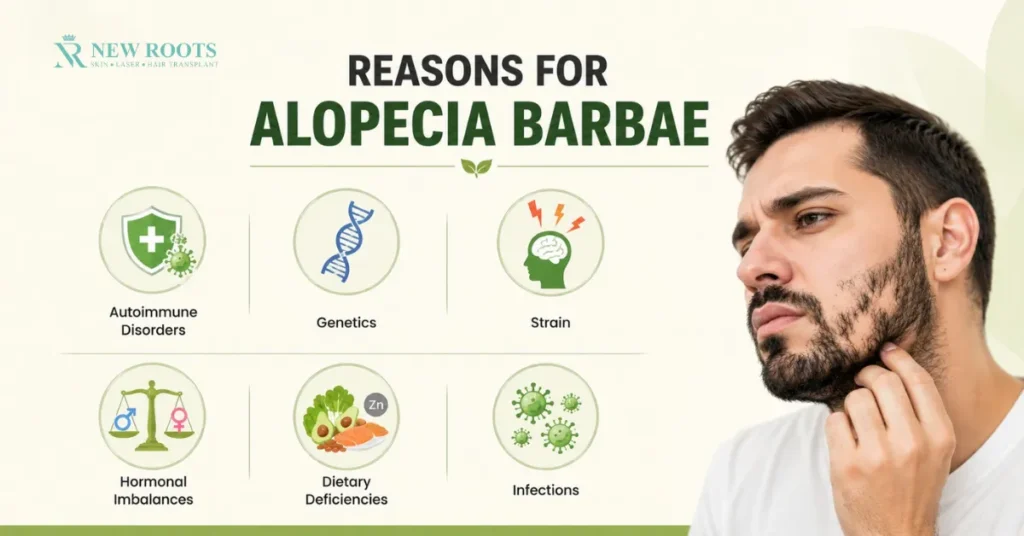
What are the reasons for alopecia barbae?
There is no one unmarried remedy for alopecia barbae if one no longer recognizes where it originated from. The following are the primary reasons for this country:
Autoimmune Disorders
Alopecia barbae is closely related to autoimmune disorders in which the body’s immune defense system targets normal hair follicles.
Genetics
It is worth noting that people with a family history of alopecia or autoimmune diseases are much more likely to have alopecia barbae.
Strain
The causes of alopecia barbae encompass anxiety or excessive pressure and stress, and it escalates or takes place while a character faces several strains.
Hormonal Imbalances
Testosterone fluctuations are regarded as secondary reasons for patchy hair loss and, consequently, will be responsible for the bald patches on the beard.
Dietary Deficiencies
It has been found that biotin, zinc, and iron deficiencies can all compromise the hair follicles.
Infections
Some infections, in conjunction with fungal or bacterial infections, may be located within the beard area, and they’ll assist in worsening hair loss in the region.
What are the signs and symptoms of alopecia barbae?
The primary manifestation of alopecia barbae is the advent of small spherical, oval, or scaly patches related to the beard area. A maximum of these patches emerge unexpectedly, just within a few days, or may also take a week or so. Extra signs and symptoms may additionally encompass:
Patch Expansion: Finally, they provoke the improvement of 1 larger region of baldness among others, beginning with several smaller patches.
White Hairs: The hair from the periphery of the bald regions may additionally finally turn white.
Pores and Skin Sensations: There’s usually itching or pain in the affected skin, earlier than hair loss happens or begins to occur. The texture of the skin inside the bald regions may vary, and the areas may also be red, swollen, or infected.
Exclamation Mark Hairs: Small, thin, little hairs at the base of the scalp that seem like exclamation marks can also surround the alopecia.
How is alopecia barbae diagnosed?
A physician or dermatologist can diagnose alopecia barbae through an examination of the patient and examination of hair samples. The following may be done for the confirmation of the diagnosis and exclusion of other possibilities:
Physical Examination: A visual inspection of the hair loss pattern and the overall condition of the skin.
Microscopic Hair Analysis: Inspection of hair samples under the microscope to determine certain features associated with alopecia barbae.
Scalp Biopsy: A skin scraping from the scalp may be taken to include the hair follicles to a greater extent in the analysis.
Testing for Other Conditions: Excluding other conditions that may lead to hair loss, like fungal diseases and disorders of the thyroid gland,
What are the medical remedies for alopecia barbae treatment?
Presently, there’s no acknowledged cure for alopecia barbae; however, there are remedies that can enable a character to experience minimal discomfort and inspire a hair boom. Those treatments are also recognized to produce effectiveness in exceptional humans and to a great extent in certain circumstances.
Corticosteroids:
- Use: Those tablets decrease the suppression of the immune system to reduce irritation that hinders hair follicles from regrowing.
- Corticosteroids may be used as a topical solution in the form of lotions or ointments, and can also be used through injections into the affected area.
- Effectiveness: When administered early enough, corticosteroids are recognized to prove useful in coping with the situation because they can assist in stimulating a hair boom.
Minoxidil (Rogaine):
- Use: This topical drug additionally applies to pattern baldness and will also stimulate hair growth in alopecia barbae.
- Topical Treatment: Carried out as a liquid or foam to the affected region two times a day.
- Consequences: it’s far from the observation that its effects can be evidenced in 3 months once it’s used in the right manner in the month. But minoxidil has mixed outcomes.
Diphencyprone:
- Movement: DPCP causes hypersensitivity, which includes erythema, edema, and itching, which is thought to alter the immune reaction far away from the hair follicles.
- Use: unfold the areas of skin to which one wants to provoke an allergic reaction to a mild stage.
- Charges: It can take about three months for the result to become quite significant.
Phototherapy:
- Knowing and know-how: this is a movement that includes the usage of light therapy to promote hair regrowth.
- Laser sorts: It involves a 308-nm excimer laser, a 904-nm diode laser, and a 1,550-nm fractional laser.
- Result: may additionally produce hair increase, although several remedies can be wished.
PRP therapy:
- Movement: Apply the affected person’s plasma containing an excessive concentration of increased elements in the affected vicinity of the pores and skin to set off the hair follicles.
- Utility: Injections of PRP into the affected regions.
- Effectiveness: can be used to stimulate hair growth with little or no adverse outcomes.
Domestic treatments for Alopecia Barbae
Even though they do not necessarily tackle alopecia barbae, they may relieve the skin and facilitate hair regrowth:
- Garlic (Lahsun): Several symptoms seem to change or even improve due to the healing properties of garlic. Some specific wipes that can be used include an ointment containing garlic diluted in a carrier oil and applied to the affected areas.
- Marine Minerals: There is evidence that supplements containing extracts from marine sources may lead to hair growth.
- Zinc and Biotin: Its users need to enhance their daily intake of zinc and biotin either from the diet or from supplements they take. They’re essential for healthy hair.
What causal links are there between lifestyle and alopecia barbae?
It must be said that the main way of dealing with alopecia barbae does not always relate to the application of beard products but to the definition of the way of life of a man. Here are some possible lifestyle changes that might bring improvement:
- Stress Management: As for a type of stress, we have already seen that it can also be invigorating in certain circumstances. Practical regulation of stress that can be achieved by such practices as meditation, yoga, or routine exercise may help maintain a healthy beard.
- Balanced Diet: To grow a healthy beard, your beard requires nourishment in the same manner as other parts of your body. Dietary ways and materials that are recommended to be included in a healthy diet include vitamin A, vitamin C, vitamin D, vitamin E, B-group vitamins, as well as zinc and iron.
- Adequate Sleep: It’s therefore important that beauty sleep is not just a preserve of beautiful princesses. Proper exposure to air is important in the body for the proper functioning of the body’s organs, and thus, one must get enough quality sleep.
- Avoid Harsh Chemicals. Be kind to your beard. As much as feasible, choose natural shampoos and soaps to avoid using merchandise that would irritate the pores, skin, and follicles.
- Stay Hydrated: It is said that water exists, and this is very true; however, that is not simply the life of a person but additionally the existence of his beard. It is, therefore, important that one stays as hydrated as possible, as this helps in general well-being and, therefore, also the hair.
How long does alopecia barbae remain?
The period of alopecia barbae depends on the reason and the treatment administered to the character suffering from the sickness.
If the hair loss is going to be rapid, depending upon the severity, it’ll appear within days at the most, but if it’s miles sluggish, it may take weeks.
Hair can and might grow back and live, but it regrows, and it may again recede or fall off. It can take numerous years between periods in most cases.
How Can Stress Management Help?
Since stress is known to cause alopecia barbae, stress by practicing relaxation exercises or consulting a counselor may help in preventing the disease. Appropriate management of psychological and physical stress may lead to a decrease in the frequency and severity of flare-ups.
Can Hair Regrow Once There Was Alopecia Barbae?
Indeed, with treatment, hair still grows back and remains, and may also again fall off. It could regrow in the same way that it was previously, and that may have a different texture and color. In some instances, there is no regrowth of the hair whatsoever.
Role of clinical treatment
Clinical trials are an important piece of knowledge regarding the knowledge and treatment of alopecia barbae. They assist scientists in determining the best time, manner, and dosage of using a new treatment or drug on its subjects.
Hence, lifetime testing can help in exploring other possibilities in a disease that can help in its treatment, as well as discover more about the causes of the illness.
Doctor Consultation
Thus, if a patient experiences alopecia barbae and its impact on the quality of life or if the cause of the condition needs to be identified, consultation with a dermatologist or doctor should be made.
They have the opportunity to determine how severe your symptoms are and devise a treatment plan accordingly. Other causes of hair loss should also be eliminated, and this can be done by seeking the help of a professional.
What is the role of New Roots Clinic in the management of alopecia barbae?
New Roots: Skin, Laser & Hair Transplant Clinic offers high-quality treatment to recover from a beard transplant as well as the best results in the procedure.
Using the best techniques is something their skilled practitioners use to ensure that they offer the best services, especially in the area of thick and natural-looking beards.
Whether due to trauma or burns, New Roots provides you with unique programs customized for each patient, and the highest level of quality in beard restoration can be expected.
Conclusion
Tired of uneven beard loss as a result of alopecia barbae? Despite this, a cure for alopecia barbae does not exist, but there is hope! Effective treatments can stimulate regrowth.
Learn the causes of the disease, how to identify it, and the possible treatment, especially from facilities with skin specialists.
At every step we take to be proactive, practice individualized nursing, and apply progressive procedures, you will see your life becoming fuller and better.
Complementary medicine in combination with the regulation of one’s diet, exercise, and counseling services.
So it is always good to take information and advice from professionals on what should be done in specific cases that one is facing. Fight back and bring back your full epidemic! For this episode, take charge of alopecia barbae!
Q&A ASK:
There is presently no recognized alopecia barbae cure; however, remedies can manage signs and doubtlessly stimulate hair regrowth. The outcome can also vary from one case to another, and some patients might also experience a relapse of signs.
No single treatment guarantees a cure for alopecia barbae. Treatments such as corticosteroids, minoxidil, and immunotherapy are some of the available remedies that seek to control the disease and promote hair growth.
At the same time, a few herbal remedies may also help; they don’t provide an assured alopecia barbae treatment. Some research suggested that garlic, dietary supplements, and vital oils have advantages in improving the signs and symptoms, but further studies must be performed.
For the reason that alopecia barbae is an autoimmune condition, there aren’t any specific alopecia barbae therapies at once targeted at the immune system. They include the use of drugs that could reduce the overactive immune system and hair regrowth treatments.
Hair transplants aren’t encouraged as a cure for alopecia barbae because the autoimmune situation can keep affecting transplanted follicles. They are perfect for different varieties of patchy beard growth that are different from the one depicted in the photo above.
As there can be no definitive alopecia barbae therapy, the focus is on finding powerful treatments, which may also take numerous months to show results. The time of regrowth, moreover, relies upon the character as well as the remedy obtained.
Medical trials are indeed exploring new healing procedures that can lead to a cure for alopecia barbae or extra-powerful treatments. It may thus be visible that engaging in any of those trials can pass in a protracted manner to assisting in the improvement of new alopecia barbae remedies.


