

Table of Contents
Hair loss is a problem that affects the confidence, appearance, and self-esteem of millions of people, both men and women. Although several treatments are available, surgical hair restoration is still the most trusted long-term solution for severe hair loss.
Among the surgical methods, FUT hair transplant is still considered a reliable and safe procedure and is performed extensively all over the world.
This guide goes through all aspects of FUT that you need to know—its mode of action, comparison with FUE, recovery time, costs, effects, and the permanence of FUT hair transplant.
If you are on the verge of hair restoration or are weighing FUE against FUT, this post will aid you in making a knowledgeable choice.
What Is a FUT Hair Transplant?
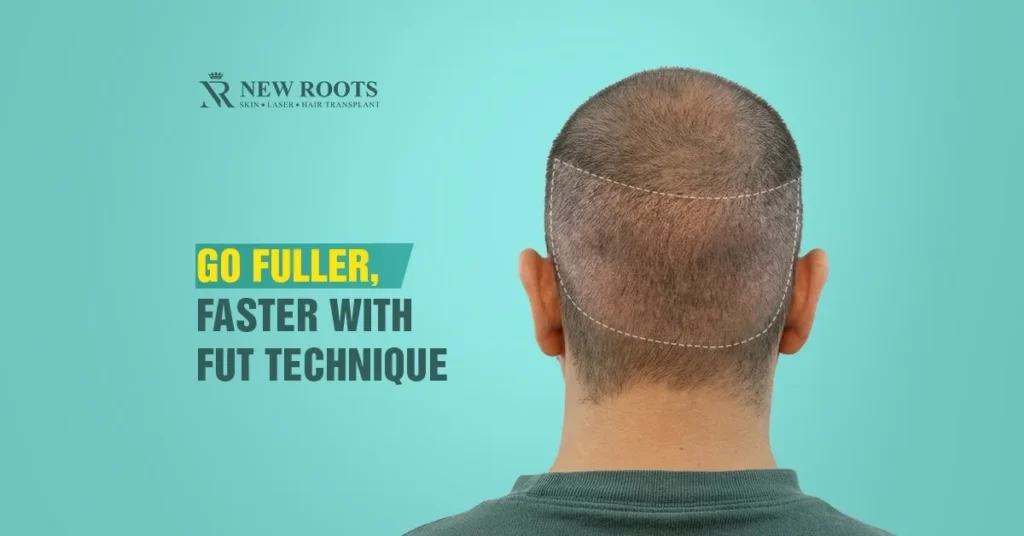
FUT (Follicular Unit Transplantation), also known as the strip method, is an operation that helps people get hair back by removing a strip of scalp from the predetermined donor area, which is usually the back of the head.
Microscopic dissection of the harvested strip follows, resulting in single follicular units that are then implanted in the areas of baldness or thinning.
FUE’s major disadvantage of single follicle extraction has been overcome with FUT’s large number of grafts harvested at one session as its major advantage.
Thus, it is very well suited for those patients suffering from extreme hair loss who need a huge number of grafts for a dense placement.
FUT Hair Transplant Procedure: Step-by-Step
Comprehending the process alleviates stress and sets practical expectations.
1. Consultation and Hairline Design
The whole procedure starts with a complete evaluation of hair loss pattern, donor density, scalp laxity, and future hair loss risk. The surgeon makes a hairline that is natural to the patient and fits the facial and age proportions.
2. Donor Strip Removal
A thin strip of scalp is removed from the donor area while the patient is under local anaesthesia. The area is then stitched using advanced techniques that are aimed at preventing scarring.
3. Graft Dissection
The removed strip is cut into pieces under a microscope to detach healthy follicular units while keeping graft survival.
4. Recipient Site Creation
Little cuts are made in the area where the hair is going to be implanted, considering the direction, angle, and density needed for natural growth.
5. Graft Implantation
The grafts that have been harvested are inserted into the receiving areas very carefully in order to have the appearance of natural results.
The overall FUT hair transplant operation usually lasts for 4-8 hours, depending on how many grafts are needed.
FUT and FUE Hair Transplant: Key Differences
When it comes to FUT and FUE hair transplant techniques, the differences are significant:
- Harvesting Method: FUT extracts a strip of scalp; FUE separates and takes out single hair follicles
- Scarring: FUT results in a long scar; FUE just has many small dot scars
- Graft Yield: FUT can do more grafts in one go
- Procedure Time: FUT is usually quicker for a large session
- Cost: The expense for a FUT hair transplant is frequently lower than for an FUE
People with large areas of baldness usually get more value out of FUT, while those who want very short hairstyles might go for FUE.

Benefits of FUT Hair Transplant
FUT hair transplant is a method that still remains the most commonly used because of its high effectiveness, backed up by the notion of permanence. It has a number of great advantages, especially for those who have been totally bald and need to cover large areas.
- The graft survival rates are higher: Grafts are obtained through very careful and skilled hands, thus less damage and better growth success.
- Ideal for severe baldness (Norwood 4–7): FUT is the right technique to cover large bald spots quickly and effectively.
- Better donor area preservation for future sessions: The donor zone is preserved in an appropriate way for further possible transplants.
- More cost-effective for large graft requirements: With a large number of grafts needed, FUT is always cheaper than FUE.
- Consistent and predictable results: The technique always results in natural-looking outcomes with the same density of hair.
For patients who want hair density to the maximum in one session and intend to have long-lasting results, FUT is definitely the favorite and practical option.
FUT Hair Transplant Recovery Timeline
The understanding of FUT hair transplant recovery allows for the planning of work, travel, and lifestyle changes.
First Week
Discomfort, pressure, and swelling are mild
Sutures are visible in the donor area
Formation of crusts in the area of the transplant
7–14 Days
The stitches are out
The scabs are starting to come off
The redness is almost gone
1–3 Months
The phase of temporary shedding (shock loss)
The transplanted hair falls out, but this is normal
4–6 Months
The start of new hair growth
At first, the hair is thin and soft
9–12 Months
Noticeable increase in density
Hair becomes thicker and less noticeable
The complete outcome is normally observed in 12–15 months.
After FUT Hair Transplant: Do’s and Don’ts
After a FUT hair transplant, proper care is very important to get the best possible results.
Do’s
During the first nights, sleep with your head raised
Be strict about taking the medications that were prescribed
Was the hair very soft, just as indicated
Go to the scheduled appointments for check-ups
Don’ts
Stay away from hard exercises for 3 to 4 weeks
Smoking and drinking are not allowed during the healing process
No scratching and no scab picking
At first, do not let the scalp get direct sunlight
A faster healing process and higher-quality grafts are ensured by following these rules.
FUT Hair Transplant Results: What to Expect
FUT hair transplant results are commonly acknowledged for their naturalness and durability when performed by a skilful and well-trained surgeon. The areas of hair growth are very similar to the already existing hair line, which makes the outcome very natural and the procedure very personal.
- Hair grows in natural direction: Perfect positioning of the grafts yields a very realistic hair line and crown coverage.
- Density looks the same and lasts forever: With FUT, you can have a big number of grafts implanted, making it possible to have high-density areas.
- Aesthetic changes take place slowly and over several months: The shedding of new hair starts after about 3–4 months, and it takes 12–15 months to see the full results.
- The transplanted hair is allowed to be cut, styled, and coloured: The hair acts like the natural one.
Very often, when the growth cycle is over, patients will report an improvement in their confidence, looks, and also a positive feeling about the whole hair restoration process.
Is FUT Hair Transplant Permanent?
A frequent worry is that the FUT hair transplant is not lasting.
Indeed, FUT hair transplant has been viewed as a permanent solution since the follicles that are transplanted come from the donor areas that are genetically hair loss resistant. These follicles, after being transplanted, do not lose this resistance to hair loss.
But still, one should keep in mind that the hair that has not been transplanted may gradually get thinner. Long-term strategies and, occasionally, medications, can be used to help keep the density of hair overall.
FUT Hair Transplant Cost in India
FUT hair transplant cost in India is determined by a variety of medical and logistical factors that have an impact on the overall pricing. A detailed consultation and scalp examination usually determines the final cost.
- The number of grafts needed is the principal factor, and thus, the more grafts that are needed, the more expensive the whole procedure will be.
- The doctor’s skill: Well-known and practiced doctors are going to charge more since they will most likely have greater success rates.
- Location and fame of the clinic: The prices are lower in smaller towns than in bigger ones.
- The use of technology and the support during and after the procedure may also play a part in the price being higher or lower.
Generally, the cost of FUT hair transplant in India is less than that of FUE, thus making it a cost-effective alternative for patients who require big graft sessions.
FUT Hair Transplant Kolkata
Kolkata has become a prominent destination for FUT hair transplant due to the city’s relatively low cost and skilled doctors.
The rates in Kolkata clinics are generally much lower than those in bigger metropolises like Mumbai or Delhi, but the quality of treatment is still guaranteed.
Many clinics have very good hospitals, new surgical methods, and very nice care after the operation, so the patient will not feel any discomfort in the process, and thus, they will not find any reason for not having the hair transplant in Kolkata.
The patient will get the best of both worlds: the modern and the traditional at the same time.
Who Should Choose FUT Hair Transplant?
FUT hair transplant is the surgical procedure that not only lasts long term but also provides the greatest hair restoration. It is typically advised for persons who:
- Experience extremely On the other hand, the procedure is particularly helpful for those with a high Norwood class and large bald regions.
- Need a big number of grafts: The technique permits collecting many grafts at once.
- Desire the highest density possible in one sitting: It is the fastest way to fully cover the head.
- Do not mind a linear scar in the donor area: The scar can usually be concealed beneath hair of medium length.
- Money is not a problem: For very large sessions, FUT is generally cheaper than FUE.
However, those who want to wear very short hair or have low scalp elasticity will not be good candidates for this surgery, as the latter might slow down the healing of the donor and the visibility of the scar.
FUT vs Modern Techniques: Is FUT Still Relevant?
FUT still holds strong relevance even with the rise of FUE. The majority of the very best surgeons continue to suggest the FUT method for large bald areas on account of its superior graft quality and total efficiency.
Sometimes, a mix of both the FUE and FUT methods for hair transplant is performed to get the most out of the donor area.
Risks and Side Effects of FUT Hair Transplant
FUT hair transplant is one of the surgical procedures that has certain minor risks and side effects, which are almost unavoidable, especially during the healing process. The greater part of these is temporary and will go away with proper after-care and medical supervision.
- Discomfort or swelling: Minor discomfort and swelling might occur in the first few days and can be managed easily through the use of prescribed medications.
- Scar in a donor site: The FUT method includes the removal of a strip of skin from the scalp, which leads to the formation of a thin linear scar that is typically covered by hair of normal length.
- Loss of sensation or pressure: The presence of temporary loss of feeling or a tight sensation in the area of the donor skin is a common symptom after the surgery, and it will eventually resolve.
- Infection: Very rare if post-operative instructions are properly followed.
If you choose an adequately qualified and experienced surgeon, the chances of experiencing any complications will be greatly reduced.
Final Thoughts
FUT hair transplant is, indeed, the most preferred technique and a permanent solution for hair loss, and is highly recommended for people who are grafting in piles.
Because of the predictability of results, the high graft survival, and the cost-saving feature, FUT remains among the leading methods in hair restoration today.
Getting to know the process, time for recovery, results, and expectations for the long term would give rise to reasonable outcomes and the happiness of the patient.
When the treatment is executed correctly and the proper care is given, FUT can be very effective in regrowing hair and in boosting confidence for a lifetime.
Frequently Asked Questions (FAQs)
Both the methods FUT and FUE are meant for different indications. In patients with a great deal of baldness and a need for many grafts at the same time, FUT is the best choice. It also provides the highest graft yield and density at a lower price. FUE is greatly wanted for small sessions and for patients who do not mind having a little scarring that is not very visible.
For sure, FUT is an everlasting method for the restoration of hair. The areas where the hair follicles are taken from are genetically resistant, so they will be there forever, growing. However, the existing non-transplanted hair can still be subjected to thinning after some time.
The healing process has three main stages, and the first one takes 10-14 days, which includes the removal of stitches. After about 3-4 months, the initial hair growth can be seen; full results of FUT hair transplant are usually assessed in the period of 12-15 months after the treatment.
Yes, FUT leaves a linear scar that is very fine and smooth in the donor area. In cases where a skilled surgeon works with modern techniques for closure, the scar is really well concealed under normal hair length.
The cost of an FUT hair transplant in India changes depending on the number of grafts, the clinic, and the city. It is generally cheaper than FUE, especially in the case of large graft sessions; thus, it is considered a cost-effective option.


