

Table of Contents
Hair loss is a gradual and biological process that takes place in stages over a long period of time.
One of the benefits of understanding hair loss stages is that it helps people to recognize early warning signs, choose the right time for the treatment, and have realistic expectations.
Many people tend to overlook the initial changes, considering hair fall as a temporary condition, only to find out later that the situation has gotten worse.
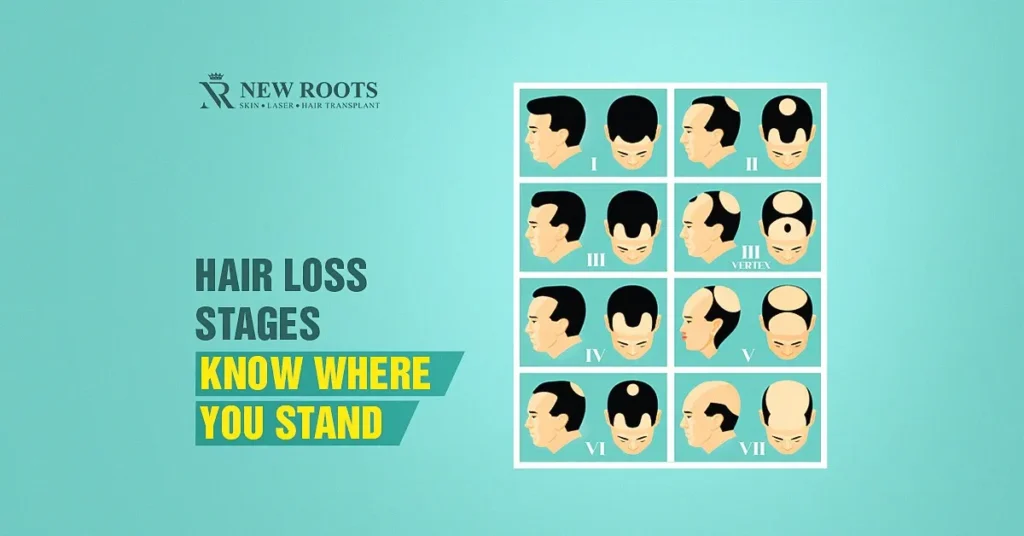
This article is about the progression of hair loss, the different types of hair loss stages, the popularly known 7 stages of hair loss, and the stages from early thinning to late balding.
Understanding Hair Loss Progression
The term hair loss progression is used to describe the process through which hair follicles become gradually weaker and smaller over time.
This phenomenon is often genetically determined, along with other factors such as hormones, age, lifestyle, and the condition of the scalp.
Each stage of hair loss indicates a more profound level of damage to the follicle.
Not every person who suffers from hair loss goes through the same changes. While some will take years or even decades to progress slowly, others will experience rapid movements through the stages of baldness in a couple of years.
Early recognition of the stage will make it possible to manage the case better and to prevent the total loss of hair that is irreversible.
Types of Hair Loss Stages
Prior to examining the stages, it is vital to know that hair loss stages may vary according to the cause of the issue.
The main types consist of:
- Androgenetic alopecia (pattern hair loss)
- Diffuse thinning
- Stress-related shedding
- Hormonal hair loss
- Age-related thinning
The article is mainly concerned with the stages of baldness linked to the pattern since they are unerringly progressive, and they are the ones that mostly result in long-term loss of hair.
Stage 1: No Visible Hair Loss (Baseline Stage)
The initial stage of hair loss does not show any signs of thinning or receding hair. The density of hair remains normal, and the hairline stays the same.
In this phase, hair follicles are in good condition and are still producing thick and strong hair.
On the other hand, if there are no signs of hair loss, it could be that genetic sensitivity has already developed.
People with a family background of baldness usually have risk factors that are not shown even before losing hair.
This phase is called preventive rather than corrective. It is very important to maintain scalp health and avoid damaging habits in this phase.
Stage 2: Mild Hairline Changes and Early Thinning
This is the first step in the hair loss process. A little bit of movement at the temples or slight thinning at the area of the crown might happen.
The alterations are so small that people often do not notice them unless there is good light or a picture is taken.
In this case, hair will feel softer, and the amount of hair being lost while washing or combing will be greater.
A lot of people think that the hair loss in this stage is due to seasonal shedding or the stress-related loss of hair.
At this moment, hair follicles are still working, but they are getting smaller. Intervening early in this stage provides the greatest opportunity to slow or stop the process of further progression.
Stage 3: Noticeable Hairline Recession or Crown Thinning
In stage three, the hair loss is undoubtedly visible. The hairline at the temples recedes even more, and the “M” shape becomes clearer, or the thinning at the crown becomes the main feature.
This progressive hair loss stage is one of the most well-known and easiest to identify stages of baldness.
Not only does hair density go down, but scalp visibility also goes up, and doing hair up becomes hard.
The hair roots are undergoing active shrinking, which results in the formation of thinner and shorter hair strands.
If no treatment is done, the progress will usually move on to the next stage quickly. During this stage, many people will be seeking advice from a dermatologist for the first time.

Stage 4: Deep Recession and Expanding Bald Areas
Significantly, stage four implies that a great deal of hair has already been lost. The hairline on the forehead disappears very much, and the spot on the crown where no hair is has become bigger. The ridge of hair that separates the forehead and crown is beginning to thin.
The hair becomes very thin and sparse. The scalp shows much more even if the hair is not parted. At this stage, using a product to cover up the hair loss is almost impossible.
Intermediate to advanced hair loss progression is what this stage stands for. Even though the hair roots might still be there, their potential for rejuvenation is very limited without medical or surgical intervention.
Stage 5: Severe Hair Loss with Reduced Density
Stage five is a major loss of hair. The areas that are going bald at the forehead and the crown become bigger and may even start to join together. The hair that is left on the sides and back of the head becomes the main source for coverage.
The hair loss stages at this point indicate major damage done to the follicles. Most of the affected ones are either in the resting phase or are producing very fine hair, which has no cosmetic value.
This stage is very hard emotionally, because the hair loss is very noticeable and difficult to cover. There are not many preventive options left, while restoration alternatives become increasingly complicated.
Stage 6: Advanced Balding Pattern
Stage six is the last step in the balding process, where the loss of hair is quite advanced. The hairline and the crown have already joined together, and there is now a big area of baldness all over the top of the head. Only the hair on the sides and back remains visible and noticeable.
At this point, nearly all the follicles in the places where hair has fallen out are inactive. There may even be a shine on the scalp, which is a sign of the long-term inactivity of the hair follicles.
The non-surgical treatments will have very little effect at this stage, so the focus will be on the stabilization, the cosmetic adaptation, or the surgical restoration strategies.
Stage 7: Complete or Near-Complete Baldness
The last of the seven stages of hair loss is characterized by almost complete baldness at the top of the head. The only hair left is in a horseshoe shape around the sides and back.
This stage indicates the complete and irreversible loss of hair follicles in the areas where the shedding occurred. The scalp feels smooth, and it is very unlikely that there will be any regrowth of hair without some kind of surgical intervention.
When the hair loss process is over, the thickness of hair cannot come back on its own. At this point, people mostly change their minds from treating the problem to simply accepting it or using very advanced cosmetic solutions.
Hair Loss Stages in Women
The pattern of hair loss stages in women is different from that of men. Women usually have thinning all over the top of the head and a good-sized frontal hairline instead of the hairline going back.
In the early stages, the hair part gets wider. In the advanced stages, there is a reduction in the overall volume and an increase in the visibility of the scalp, especially at the top of the head.
Although women do not often reach the point of being completely bald, the hair loss progression can considerably reduce and affect their self-esteem and thus their confidence.
Factors That Influence Hair Loss Progression
The speed with which a person moves through the different stages of hair loss is determined by several factors:
- Genetic sensitivity – The sensitivity of the hair follicles inherited from the parents plays a key role in determining not only the pattern but also the rate and severity of hair loss progression.
- Hormonal changes – The most significant hormonal changes are those related to the androgens, as they are the main ones that cause follicles to become weaker and to have their life cycle shortened.
- Age of onset – Hair loss that starts at a younger age is almost always more aggressive than early-onset thinning.
- Stress levels – Continuous physical or emotional stress may cause hair follicles to enter a prolonged shedding phase.
- Nutritional deficiencies – The lack of nutrients such as proteins, iron, and vitamins will make the follicles weaker and slower in their growth.
- Scalp inflammation – Problems like dandruff or dermatitis can lead to an unhealthy scalp and weakened hair follicles.
- Smoking and lifestyle habits – Smoking, lack of sleep, and bad habits reduce blood circulation and, hence, increase hair loss rate.
Why Early Identification of Hair Loss Stages Matters
Recognizing hair loss stages promptly gives one control over the result. The hair follicles in the early and mid-stages are still alive and able to respond. When the follicles are dead, regrowth becomes almost impossible.
Acting late lets the treatment free to do its worst while gradually reducing the possibilities of available treatments and, at the same time, increasing the chances of losing more hair.
Common Myths About Hair Loss Stages
The progression of hair loss is rarely understood properly, and therefore, many myths come up:
- One of such myths is that one does not always know that he is going to lose his hair forever, since it is possible that he has experienced temporary shedding due to stress, illness, or seasonal changes.
- The process of getting bald does not take so short a time, since phases of hair loss form slowly over months or years.
- Stages of hair loss are certain but not the same for every person, as living conditions and genes affect the speed and pattern of the hair loss process.
- Cutting the hair does not prevent the process from going on, for it is just that at the hair root area, not at the shaft, where the loss occurs.
- Just using oils as a treatment is not enough for the advanced stages, since the severely weakened or non-active hair follicles need more than just topical nourishment to revive them.
Knowing these facts will assist in establishing realistic expectations and avoiding unnecessary delays in the effective management of hair loss.
Managing Hair Loss at Different Stages
The progression phase of hair loss management determines the approach taken:
- In the early stages, the target is to prevent and preserve the scalp’s health since the hair follicles are still alive and responsive to treatment. The combination of good scalp care, stress reduction, and early corrective measures helps retain the existing hair density.
- During the mid stages, the objective is to slow down the entire process of hair loss, making and conserving what is left of the hair. Thinning at this point is quite noticeable and regular; the management is needed to support the hair roots that are getting weaker, and also to maintain the appearance of the hair.
- Advanced stages aim at either restoration or cosmetic alteration since most of the hair follicles are not functional anymore. The new treatment techniques focus on improving the look and controlling expectations instead of the regrowth.
There is no universal method suitable for all stages. Progression stages strategy based on individual hair loss offers better long-term outcomes.
Final Thoughts on Hair Loss Stages
Hair loss is a gradual process that takes place through distinct stages. Each step from minor thinning to total baldness signifies greater damage to the follicles. Knowledge of hair loss stages, stages of baldness, and hair loss progression is instrumental in making informed decisions.
The earlier the detection, the more powerful the tool is. Knowing the correct stage means that one can act promptly, have a realistic outlook, and possess more control over the hair’s health in the future.
Frequently Asked Questions (FAQs) on Hair Loss Stages
The term stages of hair loss refers to the gradual and time-consuming process of thinning and losing hair. They are classified from no visible hair loss to a completely bald head. The stages play an important role in determining the level of hair loss and are also a basis for making treatment or management decisions.
Hair loss is typically illustrated in terms of seven stages, which monitor the transition from early thinning to total or nearly total baldness. Not everyone goes through all the stages, and their progression varies from person to person.
It is possible to slow down or partially reverse the early stages of hair loss because the hair follicles are still working. In advanced stages, where the follicles are dead or inactive, no natural reversal occurs. Thus, early detection is very important for achieving better outcomes.
No, they are not. Generally, men have a receding hairline and thinning at the crown, while women generally have thinning all over, but with the hairline being preserved. Nevertheless, the process of hair loss is similar for both sexes.
The factors that affect the speed of hair loss are different; they include such things as heredity, age, hormones, anxiety, and way of living. The thing is, for some, it usually takes several decades to move from one stage of baldness to the next, while others might even go through all the stages in just a couple of years.


