
Table of Contents
The loss of hair is a concern not just medically and aesthetically but also psychologically, for both sexes. Among the different methods of dealing with the problem, surgical restoration has gained the most trust as the only reliable solution.
Nevertheless, every patient undergoing the procedure is primarily concerned about one thing: Is the hair transplant a permanent solution?
The decision to go for this operation requires comprehension of the hair transplant permanence, the realistic outcomes, and the long-term expectations.
This guide outlines the issue of a hair transplant being permanent or temporary, the duration of the results, the factors influencing longevity, and the reality facing patients after several years of surgery.
What Does “Permanent Hair Transplant” Really Mean?
A permanent hair transplant is described as transferring the hair follicles that are genetically resistant to loss from one region of the scalp to the thinning or bald parts. The follicles keep their original genetic characteristics post-transplantation.
Thus, the question of whether the hair transplant lasts for a lifetime actually hinges upon the personification of donor dominance.
Hair taken from the less visible and less affected back and sides of the scalp is hormone DHT resistant, the hormone known to cause pattern baldness. These follicles, once implanted, usually grow for a lifetime.
But this permanence only counts for the transplanted hair, not the already existing native hair around it.
Hair Transplant Is Permanent or Not: The Clear Answer
✔ A hair transplant is indeed permanent, but only under certain circumstances.
✔ The follicles that have been transplanted are of a permanent nature since they are taken from DHT-resistant regions.
✖ Even so, hair loss can still progress in the non-treated areas.
This is the reason why the term “permanent” regarding hair transplants is often misunderstood by patients. The operation does not prevent hair loss; it only permanently restores hair in the areas where the follicles are placed.
Hair Transplant Is Permanent or Temporary: Key Differences Explained
| Aspect | Permanent | Temporary |
| Transplanted hair follicles | Permanent | Not temporary |
| Shock loss after surgery | Temporary | Temporary |
| Native hair loss progression | Not permanent | Continues |
| Need for future sessions | Possible | Not due to failure |
Temporary shedding after surgery is normal and is often mistaken for failure, but it does not affect the permanence of hair transplants.
Is a Hair Transplant Permanent for Everyone?
The question regarding the permanence of hair transplant has different answers according to the patient factors:
Permanent Results If:
- The donor area has good-quality hair
- The patient’s hair loss pattern has stopped
- The procedure is done right
- The post-op care is done
Reduced Longevity If:
- The patient has aggressive genetic hair loss
- The donor area has poor hair density
- Incorrect surgical planning is done
- No maintenance therapy is done
So, a hair transplant permanent solution depends on proper candidate selection and honest expectations.
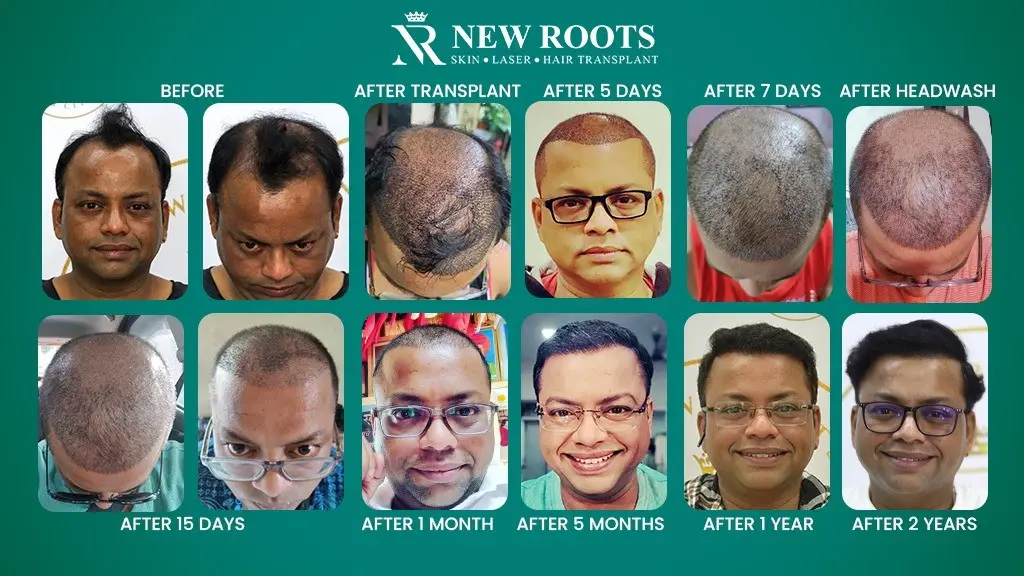
Permanent Hair Transplant Results: What to Expect Over Time
0–3 Months
- Hair that was transplanted falls off (shock loss)
- The scalp is healing
- No hair growth can be seen at this stage
4–6 Months
- New hair starts to grow
- At first, they are thin and soft
8–12 Months
- The patient will see much denser hair
- The hair becomes thicker and stronger
12–18 Months
- The results of a hair transplant are completely visible
- The natural hair growth cycle is set
Transplanted hair, once mature, acts like natural hair and lasts for years.
Hair Transplant Long-Term Results: 5, 10, and 20 Years Later
5 Years After Transplant
- Hair transplanted stays as it is
- Existing hair may lose more
- Without maintenance, the density may look irregular
10 Years After Transplant
- Hair implants are still functioning
- For aesthetic balance, extra sessions might be required
20+ Years After Transplant
- Transplanted hair typically lives on
- The total look is determined by old age and the quality of the original hair
There is clinical proof that when the transplant is performed correctly, the long-term hair transplant results are strong.
Is FUT Hair Transplant Permanent?
Yes, FUT hair transplant is permanent, which is a confident statement.
The FUT (Follicular Unit Transplantation) procedure takes away a strip of the surgeon’s scalp and inserts single follicular units. It is because the hair roots come from the area that is not affected by balding:
- FUT gives permanent results
- Almost all patients continue having living grafts for a lifetime
- Scarring is linear but not visible, as it is under the hair
FUT is usually opted for when a huge number of grafts are needed for long-term coverage.
FUE Hair Transplant: Is It Permanent?
A lot of patients frequently wonder about the permanence of the fuе hair transplant. So, the answer is yes – the outcome of FUE hair transplant is considered permanent.
In this technique, the individual hair follicles are first taken out from the donor area and then placed into the bald or thinning area.
The donor follicles have so-called ‘donor dominance’, which means that they resist DHT and keep on growing in the long run.
Nevertheless, the permanence of FUE results is subject to some major factors:
- The extraction method must be such as to avoid damaging the follicles
- Handling of grafts must be carried out in a way that the follicles are kept alive during transfer
- Surgeon’s skill, which has a direct impact on the survival of the graft
If the extraction process is not performed properly, then the follicles will get damaged, thereby reducing the survival rates. However, when done properly, FUE would yield hair restoration results that are natural, stable, and permanent.
Hair Transplant Success Rate and Its Link to Permanence
The hair transplant success rate is very important in determining the permanence of the final results, as they will be seen over time.
A higher success rate implies that a larger number of transplanted follicles have survived and are growing naturally for years. The usual success rates are determined by the technique used:
- FUT: up to 90 to 95% of grafts survive
- FUE: about 85 to 95% of grafts survive
The success rate is often calculated by taking into account the following factors:
- Graft survival, which shows how many follicles have successfully received a blood supply
- Natural growth, meaning hair goes through the normal growth cycles
- Density achievement, which shows how well coverage matches the expectations
When success rates are high, it is mainly the health of the grafts that is responsible for that being a long-term effect, thus increasing the permanent hair transplant results and also increasing the total satisfaction and the durability of the procedure in general.
Why Some People Think Hair Transplants Are Not Permanent
Misunderstandings usually happen for the following reasons:
- Shock loss – The patients may think that the transplant has failed due to the temporary shedding after surgery, even though the natural regrowth is still to come.
- Ongoing native hair loss – The thinning of existing hair around the transplanted areas may continue to create an impression that the results are not permanent.
- Poor candidate selection – Patients with low donor density or unstable hair loss patterns may suffer from visual results that are short-lived.
- Unrealistic expectations – Hair transplants can furnish hair, but not regain the density of a teenager.
Grasping these factors aids in eliminating the confusion that a hair transplant is either permanent or temporary and helps the patients to make realistic expectations grounded in medical facts.
Is Hair Transplant a Permanent Solution for Baldness?
Is a hair transplant a permanent solution? The answer to the transplanted areas is yes, since the grafts are taken from genetically resistant zones in the birthplace and usually last for a lifetime.
Nevertheless, it does not eliminate the problem of genetic hair loss completely, as over time, thinning may continue in the unoperated areas.
Hair transplant should be considered as a long-lasting cosmetic solution rather than a remedy for the genetic problem.
The majority of patients feel that their looks and self-esteem have improved throughout their lives.
In certain situations, it may be necessary to take further steps like having another transplant session, continuous medical therapy, or undergoing density refinement procedures to maintain parity and attain optimal long-term results.
Can Transplanted Hair Fall Again?
In most individuals with good health, hair that is transplanted does not fall off permanently as the follicles come from the areas of the donor that are genetically resistant. Still, in a few cases, hair loss might be experienced because of certain medical or external factors.
- If the scalp goes through severe trauma, the transplanted follicles may get damaged.
- Autoimmune scalp diseases can disrupt the natural hair growth cycles.
- Improper surgical technique may lead to the graft dying off and not being stable for the long term.
- Old age may also have an effect, such that the hair becomes thinner over a period of time.
However, even with these exceptions, the hair that is transplanted usually remains stable for decades.
This reliability over the long haul is a very strong argument for the permanence of the hair transplant, which is a good procedure, and the patient taking care of the scalp.
Maintenance and Its Role in Long-Term Results
Hair grafted is forever, but often doctors suggest maintenance that is supportive to keep the whole scalp density and the look.
- Medications that block DHT are the ones that slow or prevent the loss of the remaining non-transplanted hair.
- Scalp care, which includes proper hygiene and nourishment, creates a conducive environment for hair growth.
- Modifications in lifestyle, such as good nutrition, managing stress, and getting enough sleep, all result in hair that is healthier.
These precautions are not a problem for implanted hair follicles, which have already been made permanent, but they are very important in the long-run for hair protection, naturalness, and balance.
Hair Transplant Is Permanent or Not: Final Medical Verdict
From a clinical perspective:
- The hair follicles that have undergone transplantation are everlasting since they were extracted from the DHT-resistant regions.
- The hair that has undergone transplantation is coupled with the natural cycle of hair growth, consisting of the phases of hair shedding and hair regrowth.
- Results in the majority of patients stay stable and visible for approximately 30-40 years.
The inquiry whether a hair transplant is permanent or not can be addressed in this way: the hair transplanted becomes an irreversible restoration of hair in that area.
However, the long-term appearance and density of the hair are influenced by a variety of factors such as individual genetics, the surgical method used, overall health, and adherence to aftercare and maintenance.
Conclusion: Does Hair Transplant Last Forever?
In the majority of situations, a hair transplant will last for good—usually, the hair that is transplanted lives as long as the person who has it because the hair roots are taken from the areas of the scalp that are genetically resistant to hair loss.
The outcome is natural, stable, and the hair continues to grow normally. Both the FUT and FUE methods provide permanent results when done right.
Still, the surgeon’s skill, the patient’s characteristics, and the care given after the procedure are the three key factors that will dictate whether the success will be long-term or not.
A good knowledge of the hair transplant’s permanence will help the patients adjust their expectations and thus quite assuredly pick a trustworthy, long-term answer for their baldness problem.
FAQs on Hair Transplant Permanence
Yes, a hair transplant is regarded as permanent since the follicles that have been transplanted are taken from the scalp areas that are resistant to DHT. These follicles typically keep on growing for a lifetime. Nevertheless, natural aging and the loss of surrounding native hair can still happen.
Hair treated with transplant is generally always there and does not fall due to genetic baldness. There is a normal shedding after surgery that is part of the growth cycle. Once regrowth takes place, the results are long-lasting and stable in the majority of patients.
Yes, both FUT and FUE hair transplants are permanent. The permanence depends on the quality of the donor hair, not on the technique used. FUT may, in some cases, provide a higher graft survival rate, while FUE leaves less of a scar and gives the same long-term results.
Hair transplant is a permanent solution for the restoration of hair in the areas that are transplanted, but it does not halt future hair loss in the areas left untreated. Several patients opt to combine surgery with medical treatment to keep the overall density and balance.
Long-term hair transplant success rates usually range from 85% to 95%. The success of the procedure depends on several factors, such as the surgeon’s skill, graft survival, patient’s health, and post-procedure care, all of which are very critical in influencing the permanent hair transplant results.


