

Table of Contents
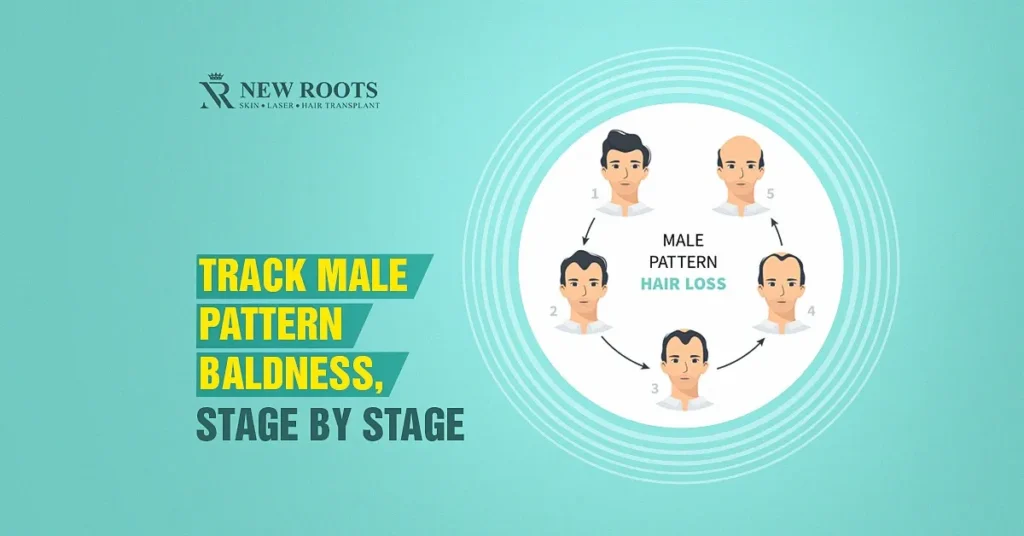
Men’s hair loss is not abrupt—it takes a predictable and gradual course called the male pattern baldness. Androgenetic alopecia is the medical term for this condition, which affects a vast number of men at least once in their lifetime.
Knowing the stages of male pattern baldness helps to capture early signs, set achievable expectations, and select the appropriate treatment at the ideal moment.
Male baldness is largely influenced by two main factors: heredity and hormones, especially the reaction to dihydrotestosterone (DHT).
When hair follicles become more and more responsive to DHT, they slowly die out, resulting in less hair and finally hair loss. This whole thing takes place in different hair loss stages, which are usually marked out by the Norwood scale.
To put it differently, this comprehensive manual describes the men’s balding stages from the initial symptoms to the very advanced hair loss in such a way that one could easily spot the progression and deal with it in the right way.
What Are Male Hair Loss Stages?
The male hair loss stages depict the slow, temporal pattern in which scalp hair gets thinner and eventually disappears. The whole process is generally quite gradual, taking place over many years or even centuries in rare cases.
The extremes of the condition can vary from only a slight recession in some men to complete baldness in others.
The main features of the male hair loss stages are as follows:
- Hairline that recedes
- The crown that thins
- Hair follicles that become smaller
- Ultimately, there is no longer any visible hair in the areas affected
Prompt recognition of the stages of baldness helps to get the appropriate treatment in time, which can considerably reduce or even stop hair loss.
Stage 1 Hair Loss: Normal Hairline
The first stage of hair loss is characterized by an ideal and youthful hairline with no detectable balding area. The following statements can be made about this stage:
- The hairline is still the same
- The corners of the forehead have not lost any hair
- The thickness of hair is the same all over the head
This stage is not referred to as hair loss. Most mature men keep a very slightly receded hairline, which lasts for years without going further. There is no hair loss on the top of the head, and the coverage of the entire scalp is complete.
Very important to mention that preventive treatments should be done at this stage when necessary, especially for men whose relatives have suffered from baldness.
Stage 2 Hair Loss: Early Receding Hairline
Stage 2 hair loss is characterized by seeing bald patches on the scalp for the first time. It is one of the earliest and most neglected stages of male hair loss that still holds the fate of future hair loss in the balance.
Main characteristics are:
- Moderate receding at one or both temples
- Formation of a slight “M” shape in the hairline
- Usually, the crown area is intact
During this period, hair falling is usually not seen unless one happens to look closely or the person is in a photograph taken from a distance.
Most men consider this a common mature hairline. However, the symmetrical receding at the temples is an early sign of androgenetic alopecia.
Hair follicles are getting smaller under the influence of DHT, but the overall density of hair is still good.

Stage 3 Hair Loss: Clinically Significant Balding
Stage 3 hair loss is generally regarded as the first stage of male pattern baldness that is well-delineated. The loss of hair is already quite noticeable to other people.
The main features are:
- Significant receding hair at the temples
- Clearly defined M-shaped hairline
- Possible slight loss of hair at the crown (in some men)
This stage is a watershed in the balding process since it is no longer a matter of cosmetics but rather progressive hair loss. The hair becomes thinner, shorter, and lighter in color owing to follicle miniaturization.
In the absence of treatment, the majority of men at this stage continue to face the problem of hair loss getting worse.
Stage 4 Hair Loss: Front and Crown Separation
Baldness reaches its highest point at stage 4, and bald places specifically on the head become evident.
The most significant indications are:
- Considerable recession at the front hairline;
- Bald spot or noticeable thinning at the crown;
- A band of hair that is very noticeable and separates the front and crown areas.
The hair density goes down drastically, and the hair becomes harder to style. The scalp also becomes more visible, particularly under the bright lights. This stage clearly portrays the progression of male pattern baldness stages.
Stage 5 Hair Loss: Expanding Bald Areas
By the end of stage 5, hair loss has progressed, and the baldness takes over almost the whole head. By this time, it is very clear across the scalp that one has lost hair, and there is a very limited range of options.
The features of this situation are:
- The scalp from above is seen more easily as the bald spot on the crown is more extensive.
- The frontal hairline has receded even more, which has increased the size of the forehead.
- The hair between the front and the crown is getting thinner, thus indicating that bald zones are merging.
The little that is left of the hair is going through severe follicular miniaturization and thus becoming sparse, thin, and weak. At this stage, non-surgical treatments would only help slow down the process of hair loss; however, they are usually not able to restore the lost hair completely.
Stage 6 Hair Loss: Extensive Baldness
Stage 6 hair loss occurs when the majority of the upper scalp has become bald, which means that the male pattern baldness has reached an advanced stage. It will no longer be possible to segregate hair loss into a few areas, and hair will be seen everywhere clearly.
Main features:
- Merging of the bald areas in the front and crown, resulting in a very large bald area
- Scanty hair is left at the top, which is weak and thin
- The hair lives primarily on the sides and back of the head, places that are DHT-resistant
This stage is one of the advanced hair loss stages where the hair follicles in the affected areas are more or less inactive. Natural regrowth is next to impossible, and treatment options revolve around management or restoration methods mainly.
Stage 7 Hair Loss: Advanced Male Pattern Baldness
Stage 7 hair loss is the latest and most extreme male pattern baldness that one can possibly reach. By this time, the hair has gone through a lot of shedding, and the top of the head is mostly bare, with just the scalp showing.
Main characteristics:
- Baldness all over the top of the scalp, and not even the tiniest baby hairs can be seen growing
- A very thin strip of hair, shaped like a horseshoe, is left around the sides and back, which is genetically resistant and remains
- Bald areas of the head cannot be regrown naturally, as the hair follicles are no longer active
Only a few options remain at this stage for hair restoration, which are mainly cosmetic solutions or surgical procedures intended to enhance appearance instead of natural growth repair.
Why Male Pattern Baldness Progresses Gradually
Androgenetic alopecia, also known as male pattern baldness, comes about as a result of the biological process of follicular miniaturization.
With each cycle of hair growth, the already affected follicles, in this case, the male ones, make hairs that are thinner, shorter, and weaker than before.
At last, the follicles shrink so much that they cease to produce even the finest hair, thus leading to a slow but sure hair loss instead of bald spots forming overnight.
The entire process is gradual; however, several important factors point the way to its slow unfolding:
- Genetics: The inherited trait of hair follicle sensitivity determines the start of hair loss, its speed, and the final degree of baldness.
- Hormonal sensitivity: Greater sensitivity to the androgen DHT speeds up the process of follicle deterioration.
- Age: Aging reduces hair replacement gradually and increases the hair growth cycle.
- Scalp condition: Poor scalp health, such as weak blood circulation, inflammation, or other scalp disorders, can lead to faster hair loss.
The rate at which male pattern baldness occurs is widely different among men, which can be the reason why some men have a few strands of hair left after an extended period, while others are already completely bald.
Can Hair Loss Stages Be Stopped or Reversed?
Treatments work best in the early stages of balding as the hair follicles are still alive and can produce hair.
Although natural reversing of advanced hair loss stages is not possible, the slowing down or even stopping of the process is often possible if the right actions are taken early.
Quick treatment takes care of the already existing hair and postpones the thinning process.
The following are general management options:
- DHT-blocking treatments: These are responsible for reducing the hormone that causes follicle miniaturization and then decreasing the process of genetic hair loss.
- Scalp health improvement: The hair growth process gets the right environment owing to proper cleansing, circulation support, and scalp care.
- Lifestyle and nutritional support: Overall hair health is supported by adequate protein, vitamins, minerals, stress control, and sleep.
- Medical or surgical intervention for advanced stages: These options are only considered when a given amount of hair loss has already taken place.
Psychological Impact of Hair Loss Stages
Hair loss has a significant impact on the individual’s image, and it includes a lot worse things. For instance, in the case of men, the whole scenario may look like this:
- Lost self-confidence: In the first place, gradually thinning hair or a receding hairline can affect one’s image and create discomfort in both personal and business interactions.
- Anxiety or stress: The early hair loss stages can cause a lot of concerns about the rapid progression, thus making one constantly worried about their looks and their future baldness.
- Social withdrawal: a few men will not go to social meetings, take pictures, or be in public places out of shame or the fear of being judged.
Conclusion: Know Your Hair Loss Stage
Male pattern baldness is a condition that has a very specific and gradual progression, which sometimes starts quite subtly, with the patient being almost unaware of the process, and only later is the prominence of the disease observed.
Knowing about the stages of male pattern baldness—from stage 1 hair loss to more advanced stages—enables men to act in a timely and informed manner.
Being aware in the beginning makes it more likely to save and keep the existing hair, as well as to find the right management options before very deep thinning happens.
The most crucial point is pretty much the same: the treatment options at the early stages are many and wide, but the opposite is true for the later stages of baldness.
Being aware of your situation is the beginning of the road to the application of efficient management, and it will help you not to take panic-driven decisions.
Once you know your current position in the hair loss stages, it will be easier to set realistic expectations, and it will also feel more practical and achievable to choose the right, stage-specific solutions.
FAQs on Male Pattern Baldness Stages
The stages of male pattern baldness refer to the gradual and predictable hair loss in men. The process usually starts with a receding hairline or the thinning of the temples, and later affects the crown of the head. The bald spots get bigger with time, and they might come together, resulting in a bald spot, either partially or completely, at the top. The classification of the stages allows both the practitioner and the patient to know the degree of baldness and the treatment options that might still work.
The first stages of male hair loss can show up as early as the late teens or very early twenties, but the timing is highly individual. Genetics is the major factor. Some men see thinning at the front or crown in their early 20s, while others can go on bald-free until the age of 30 or even 40. It is the ones who lose their hair early that always have quicker progression through the stages of balding.
If you treat the first stages of baldness, especially the first two, the hair will regrow in most cases. Reversal of genetic hair loss is tough, but in many cases, the loss of hair can be slowed down considerably. At these stages, the hair follicles are still active, and that makes them responsive to medical and lifestyle-based interventions.
Stage 3 is the point where the hair loss is considered to have reached the first clinically significant stage. The hair density on the scalp has decreased to such a degree that the hairline recession is now clearly visible, and the hair at the crown may start to thin as well. Without treatment, the usual course of male hair loss is further advancement into more severe stages of hair loss.
The answer is no; not every man will end up with baldness. Some men continue to have slight baldness all their life while there are others whose baldness progresses very rapidly. The causes of baldness are mainly genetic, hormonal, and environmental factors.


