
Crown part of the head, hair loss is one of the most frequently experienced, along with it, and at the same time, it can be confusing for men and women alike.
It usually happens that someone will see hair falling off neatly at the very top back part of the scalp, yet will not know for certain if it is just normal shedding, an early stage of baldness, or a medical issue.
If one can point out the crown, then the reason for starting hair loss there, along with the right treatments, will surely guide him/her to take timely and effective action.
This comprehensive guide covers the definition of the crown area of the head, the most common causes of hair loss, the early warning signs, and the treatment options available for the crown area of the head, including the follicular unit extraction (FUE) and the crown area of the head implant.
Table of Contents
What Is the Crown Area of the Head?
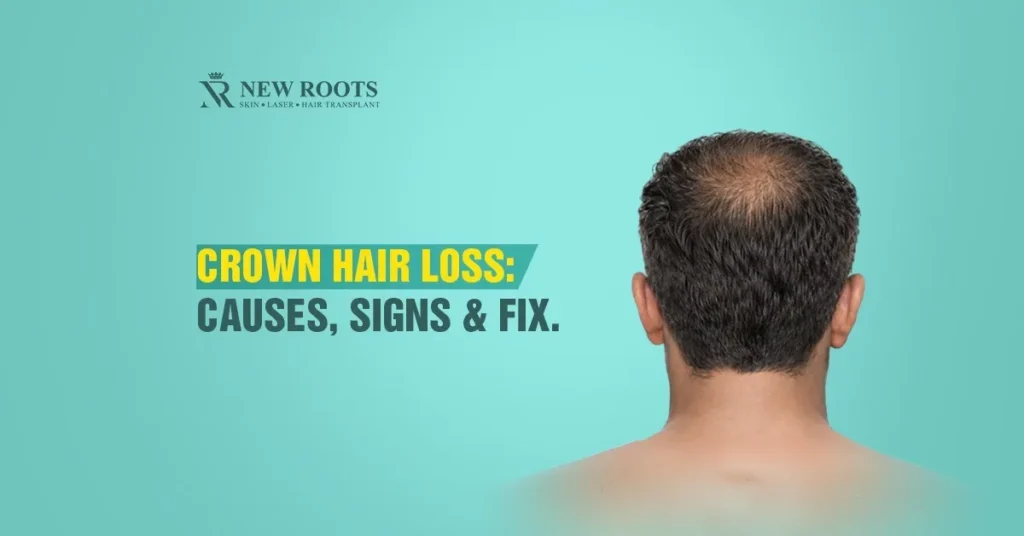
The crown area of the head denotes a circular area situated at the upper-central part of the scalp. It is located between the frontal hairline and the back of the head, just a little behind the skull’s midpoint.
In case you’re asking yourself where the crown area of your head is, just think of putting your hand flat on the top of your head and pushing it a little backward—this, in fact, is the crown.
It is sometimes referred to as the top crown area of the head and generally is the spot where hair grows in the form of a natural whorl or spiral pattern.
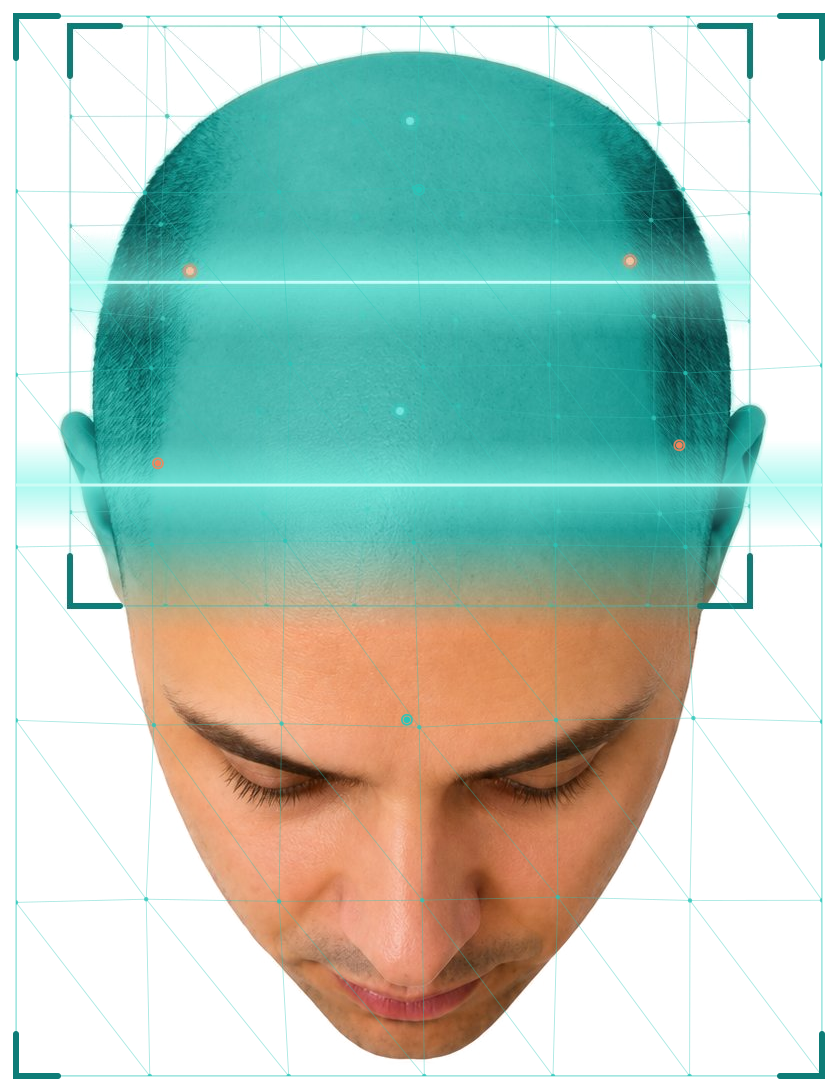
Thinning in the crown area of my head is normally more prominent under bright light or when seen from above due to the shape and direction of hair growth.
Why is the crown area prone to Hair Loss?
The crown region of the scalp is very susceptible to hormones, blood flow variations, and heredity. That is why it is often the first area to reveal thinning, especially in androgenetic alopecia (pattern hair loss).
The principal causes are:
- DHT (dihydrotestosterone) has higher sensitivity
- Lower hair density in growth at the frontal hairline
- Round hair growth pattern that reveals the scalp faster
- Decreased blood supply due to age
All the above factors account for the reason that most people see the crown area getting thinner before any other region.
Common Causes of Hair Loss in the Crown Area of the Head
1. Genetic Hair Loss (Androgenetic Alopecia)
The principal reason for thinning at the top of the head in a hereditary manner is the genetically predisposed loss of hair. In males, it typically starts with the gradual development of a barren spot at the top of the head and then covers more area gradually.
In females, it manifests through the thinning of the hair without a completely bald spot in the right top area of the head. The condition is progressive and indisputable; it will continue to deteriorate until the situation is addressed.
2. Hormonal Imbalances
Hair loss in the crown area of my head can be caused by hormonal variations due to the presence of thyroid disorders, polycystic ovary syndrome (PCOS), menopause, or high-stress levels.
The hormonal fluctuations directly affect the hair growth cycles, resulting in the production of less new hair and more shedding.
3. Chronic Stress and Lifestyle Factors
Stress is one of the biggest reasons hair follicles get into the resting phase and lead to excessive shedding called telogen effluvium.
Stressful life, smoking, poor sleeping habits, crash dieting, and no exercise at all can speed up the process of hair loss in the crown area of the head.
4. Nutritional Deficiencies
Inadequate intake of iron, vitamin D, zinc, biotin, and proteins may lead to weakened hair roots. Since the scalp area is so sensitive already, the deficiency in nutrition will first be seen in the form of thinning hair here.
5. Scalp Conditions and Infections
The top area of the head can get rid of hair due to conditions like dandruff, fungal infections, seborrheic dermatitis, and psoriasis. One should not ignore persistent itching, redness, or scaling.
6. Tight Hairstyles and Mechanical Stress
The hair loss problem can be caused by repeated stress from tight hairstyles, such as buns or ponytails, or even wearing headgear. Eventually, traction affects the top of the head, especially when combined with other risk factors.
Early Signs of Hair Loss in the Crown Area of the Head
Timely intervention and better long-term results are possible only when early hair loss in the crown area of the head is recognized. Usually, the subtle changes progress gradually, and without careful observation, they often get overlooked easily.
Be on the lookout for the following warning signs:
- Greater visibility of the scalp in the crown area, more so under bright light
- Hair being styled in such a way that it actually looks flat or thinner
- A small, round bald patch at the crown that is gradually enlarging
- Hair regrowth after the normal shedding cycle is taking place very slowly or is very weak
- There is a lot of hair falling off during washing, combing, or on pillows
- The scalp in the crown area is itching or hurting due to inflammation or scalp sensitivity
Taking pictures from above every couple of months will help track the progression of the condition objectively and also spot early thinning patterns.
Pain in the Crown Area of the Head: Is It Related to Hair Loss?
Head pain in the crown area is often accompanied by a noticeable loss of hair in many people. The pain may be felt as tenderness, burning, or tightness around the scalp. Pain does not lead to hair loss directly; however, it is often linked with conditions that impair the health of the follicles.
The reasons that give rise to such a situation are:
- Increased sensitivity, commonly known as trichodynia, inflammation of the scalp
- Stress-causing muscle tension can affect the circulation in the scalp
- Blocked hair follicles due to an excess of sebum
- Irritation caused by scalp infections or dermatitis
- And, of course, hypersensitivity during the active hair loss phases
To sum up, pain does not mean baldness, but usually, it does indicate a scalp or health problem. If not treated on time, these causes can lead to hair loss in the crown area, which will require an early evaluation to prevent.
How Is Crown Area Hair Loss Diagnosed?
Determining the reasons for hair loss in the area of the top of the head is an intricate process that needs thorough and slow assessment to clarify the root cause and the degree of thinning. The correct diagnosis can indicate whether the condition will disappear, will be gradual, or is due to genetics.
A proper diagnosis comprises:
- Visual scalp examination to see the distribution of thinning
- Trichoscopy to observe the miniaturisation and density of the follicles
- Hair pull test to reveal the extent of active hair loss
- Blood tests to find out about deficiencies in vitamins and minerals or imbalances in hormones
- Discussion of family history and lifestyle factors that affect hair health
Correct diagnosis assists in providing appropriate treatment for the area of the head crown, and this is done by completely avoiding ineffective treatments that are universally applied.
Treatment Options for Crown Area of Head Hair Loss
1. Medical Treatments
Growth stimulants and other topical solutions are some of the methods used to treat hair loss, and they make sure that the follicles that are still alive go through the growth phase for a longer time.
Doctors usually give these treatments to people suffering from hair thinning on the top part of their heads.
Hormonal therapy might help to lessen the follicles’ hormonal impact; in case of hereditary baldness, the doctor might suggest it.
A patient needs to be very consistent with the treatment, as results are usually seen only after 4-6 months.
2. Nutritional and Lifestyle Corrections
Surely, the gains made by treating the deficiencies would be very noticeable in the quality of the hair at the top crown area of the head.
Eat a varied diet containing sufficient amounts of the following nutrients to keep the follicles healthy: proteins, iron, omega-3 fatty acids, and antioxidants.
On the other hand, stress relief through yoga, meditation, and regular workouts will also have a big impact on your hair.
3. Advanced Non-Surgical Treatments
PRP (platelet-rich plasma) therapy was one of the least invasive methods that I had in mind, and it has already been acknowledged in scientific literature as a powerful stimulator for the dormant hair follicles and the one that promotes hair thickening in the vertex. These treatments are the most effective in cases of early to moderate thinning.
The low-level laser therapy could also be a possible enhancer of the cellular activity in the follicles.
4. Crown Area of Head Transplant
The situation of hair loss is difficult; thus, the crown area of a head transplant might be the best solution. The current technique entails taking the already existing grafts in the donor area and putting them in the area where you have already developed some hair loss in the crown.
The main aspects of crown transplants are as follows:
- Delicate angle and direction placement necessary
- Circular grafting pattern often results in the need for more grafts
- The result probably would take 9–12 months to show completely
- In most cases, it’s a good idea to combine it with medical therapy
Due to the fact that the crown is a very sought-after area, it is essential to consider surgical planning in a way that it gives a naturally looking density.
Can Crown Area Hair Loss Be Reversed?
In the case of early-stage thinning in the crown area of the head, it is possible to actually stabilize and, in many instances, partially reverse when treatment is initiated at the right time.
Active hair follicles are likely to respond positively to medical and scalp-centered therapies.
On the other hand, if the hair follicles in the crown area of the head are completely inactive, it is not possible to expect natural regrowth without surgical intervention.
Basically, the best results are usually reached through the combination of:
- Early diagnosis
- Medical treatment
- Lifestyle optimisation
- Long-term maintenance
A consistent, multi-step approach offers the highest chance of preserving and improving the density of hair in the crown area.
How to Prevent Further Hair Loss in the Crown Area of the Head
The prevention of hair loss in the top of the head area is mainly done by taking care of the current hair roots and delaying the process of thinning. Acting early can lead to a big change, more so if done when the hair roots are not yet permanently weakened.
The list of preventive measures includes:
- Not using harsh hair products and also discarding heat styling
- Scalp and hair care to maintain cleanliness and avoid inflammation
- Stress management and better sleep
- Having a balanced diet rich in certain vitamins and minerals that promote hair growth
- Taking action immediately when thinning is noticed
The easiest way is to prevent rather than to restore, especially at the top of the head, where the loss of hair is an ongoing process, and it occurs gradually.
Final Thoughts
Crown hair loss is a common issue; however, it can be controlled through the right methods.
Getting the definition of the crown area of the head, spotting early signs, and selecting the right treatments can remarkably slow down the process and make the condition look better.
If you have started experiencing light thinning, discomfort in the form of pain around the crown area of the head, or thinking about a crown area of the head transplant, professional help early on is crucial.
With a prompt response and dedication, the hair in the crown area can be well protected and restored nicely.
FAQs: Crown Area of Head Hair Loss
The crown area of the head is the upper back part of the scalp where a natural hair swirl usually occurs. This part of the scalp is more reactive to hormones like DHT, is less populated with hair, and thus hair loss and thinning usually start in this area sooner than in the other parts of the scalp.
If you put your hand on the upper part of your head and move it a little backward, you will be at the crown. It is located between the front hairline and the back of the head and can often be seen from above.
Scalp pain in the crown area is not always a direct factor for hair loss, but it can be a sign of such problems as scalp inflammation, stress, or infections. If these conditions are not treated properly, they might lead to an increase in shedding, so a medical assessment is recommended.
Yes, if the thinning in the crown area of the head is still in its early stages, it can often be treated positively with a combination of medical treatments, lifestyle changes, and proper nutrition. Advanced baldness usually necessitates a crown area of head transplant for visible restoration.
A crown area of head transplant is viewed as permanent because the transplanted hair follicles are not prone to loss. However, the existing organic hair may continue to thin, thus maintenance treatment is still very important.


